Recipe
Servings
Servings 1×
Ingredients
- Tofu
- Rice
- Greens
- Soy sauce or tamari
- Salt
- Black pepper
Method
- Prepare the ingredients described in the article and heat the cooking surface or oven as directed.
- Cook the main ingredients using the heat and timing guidance in the article.
- Finish with the seasonings and garnishes named in the article, then serve.

If you have ever stared at a jar of bubbling, funky cabbage and wondered if it was a science experiment gone wrong or a culinary masterpiece, welcome to my blog. We are diving deep into the world of fermentation today, but we aren't going to wait weeks for results. Most people think fermentation is a slow-motion marathon, but I prefer to think of it as a high-stakes drag race. By understanding the kinetics, the literal speed of the chemical reactions, you can manipulate your kitchen environment to produce world-class kimchi that fits perfectly into your rotation of healthy dinner ideas.
The Thermodynamics of the Crunch: Osmosis and Bacterial Kickstarts
To get your kimchi moving at lightning speed, you have to master the first law of fermentation: osmotic pressure. When you apply high concentrations of salt to Napa cabbage, you aren't just seasoning it; you are launching a biological assault on the vegetable's cellular structure. Salt draws water out through the cell walls, a process called osmosis, which collapses the rigid cellulose and creates a brine. This brine is the "ocean" where your beneficial bacteria, primarily Lactobacillus, will swim.
Use coarse salt for this stage. Avoid fine table salts with iodine, as iodine can inhibit the very microbes we want to invite to the party. The "quick" in quick refrigerator kimchi comes from the concentration of your salt rub and the temperature of your starting environment. If you want to speed up the kinetics, don't just toss the salt; massage it in with vigor. This mechanical action breaks down the cell walls faster than passive soaking ever could.
Once the cabbage is wilted and the water has been expressed, you introduce the fuel: carbohydrates. In traditional recipes, this is often a rice flour porridge. From a kinetic standpoint, this porridge provides "bioavailable" sugars. The bacteria don't have to work hard to break down complex fibers; they can go straight for the easy sugars, sparking a rapid drop in pH. A lower pH means more acidity, which acts as a safety barrier against the bad guys (mold and rot).
Temperature is your primary kinetic throttle. If you leave your jar on the counter at 70°F, the bacteria will reproduce exponentially, creating those beautiful carbon dioxide bubbles. However, if you let it go too long at room temperature, the acidity becomes aggressive and the cabbage loses its structural integrity, turning into a mushy mess. The "refrigerator" trick is about using thermal energy to hit the brakes. By moving the jar to the fridge after just 24 to 48 hours, you slow the bacterial metabolism to a crawl. This preserves the crunch while allowing the flavors to meld and deepen over a week. It’s the ultimate hack for quick family meals where you want big flavor without the three-week wait.
Strategic Variations: Surface Area and Catalyst Tweaks
Not every vegetable reacts to fermentation kinetics the same way. If you want to vary your kimchi, think about surface area. A whole head of cabbage has a much lower surface-area-to-volume ratio than cabbage that has been shredded or chopped into small squares. More surface area means more room for the bacteria to colonize and a faster salt-exchange rate.
If you are using daikon radish (Kkakdugi), the kinetics shift because the radish is much denser than the leafy cabbage. Radish requires a longer "kickstart" at room temperature because the salt takes longer to penetrate the center of the cubes. If you find your kimchi isn't "zippy" enough, consider adding a teaspoon of raw sugar or even grated pear. These additives act as a chemical catalyst, giving the Lactobacillus an immediate energy source to begin the acidification process.
For those who prefer a vegan profile, you can swap traditional fish sauce for seaweed broth or soy sauce. Scientifically, fish sauce provides a massive hit of free amino acids (glutamates), which are the building blocks of umami. If you skip the fish sauce, you must ensure your "quick" version has enough salt to maintain the osmotic pressure required to prevent soft-rot bacteria from taking over.
Balancing the Funk: Side Dish Pairings
Kimchi is a powerhouse of acidity and heat, which means it needs a partner that can handle the intensity. The best pairings usually involve fats or starches that can coat the palate and provide a neutral backdrop for the kimchi’s complex fermentation byproducts.
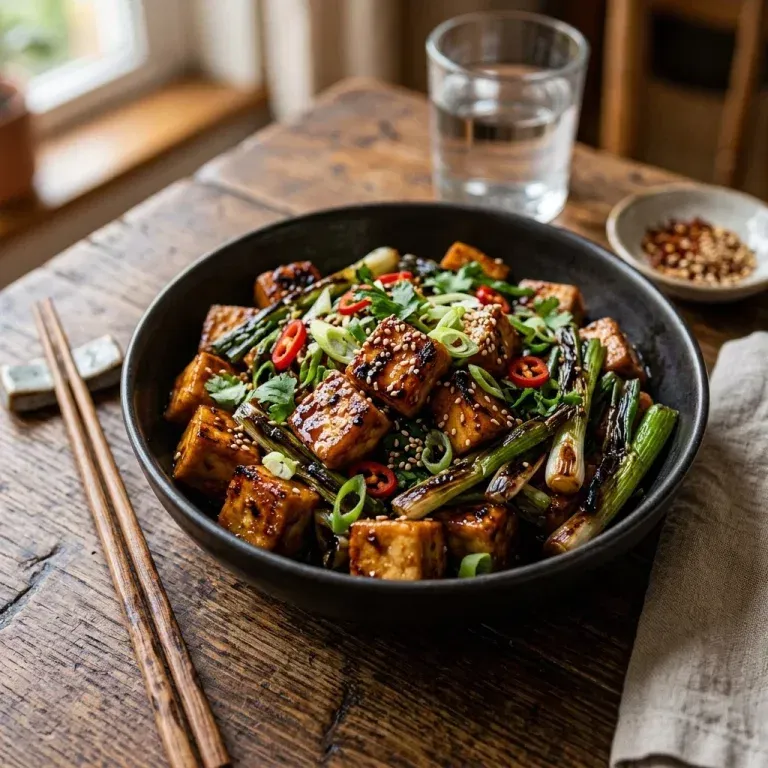
I love serving a cold, crisp kimchi alongside a warm bowl of crispy air-fried tofu. The Maillard reaction on the tofu provides a toasted, nutty contrast to the sharp, lactic tang of the cabbage. If you are looking for more air fryer recipes dinner ideas, consider serving your kimchi with kielbasa and pierogies. The richness of the sausage and the starch of the pierogies are perfectly cut by the acidity of the kimchi, creating a balanced bite every time.
For a lighter option, a simple shakshuka or a sausage and pepper medley works surprisingly well. The sweetness of roasted peppers complements the spice of the gochugaru, making for a truly vibrant dinner.
FAQ: Troubleshooting Your Microbial Microcosm
Why is my kimchi bubbling so much?
Congratulations, you’ve witnessed the production of carbon dioxide! This is a byproduct of the bacteria metabolizing sugars. In the early stages of fermentation, Leuconostoc bacteria are the stars of the show, and they are very "gassy." If you see bubbles, it means your kinetics are healthy. Just be sure to "burp" your jar once a day to prevent pressure buildup.
Is it normal for the brine to turn cloudy?
Yes, absolutely. As the bacterial population explodes, the liquid will lose its transparency. This cloudiness is actually a visible sign of the microscopic life thriving in the jar. If the liquid stays crystal clear, your fermentation might be stalled, check your salt levels or move the jar to a slightly warmer spot.
Why did my cabbage turn mushy?
Mushiness is usually a sign that the fermentation temperature was too high for too long, or you didn't use enough salt. High heat speeds up the enzymes that break down pectin (the "glue" that holds plant cells together). To keep it crisp, move the jar to the refrigerator sooner.
There is a white film on top of the liquid. Is it ruined?
Not necessarily. This is often "Kahm yeast," a non-toxic aerobic yeast that grows when the kimchi is exposed to too much oxygen. While it’s not harmful, it can affect the taste. Scrape it off and ensure your cabbage is fully submerged under the brine. Remember, fermentation is an anaerobic process; keep the air out!
How do I know if it’s safe to eat?
Trust your nose. Fermented food should smell "funky," "sour," or "tangy." If it smells like something died, or if you see fuzzy green or black mold, toss it. The drop in pH is your safety net; as long as the environment stays acidic and salty, the bad bacteria can't survive.
Can I use this in cooked dishes?
Yes! In fact, older, more acidic kimchi is a secret weapon for stews and stir-fries. The lactic acid survives the cooking process and provides a deep, complex sourness that you can't get from vinegar alone. Use it to elevate your healthy dinner ideas by adding a handful to your next fried rice or soup base.